Business activities are slowing down on yarn markets in Pakistan, in line with a lack of demand from China. Lower cotton prices have helped spinners in slightly reducing their offers for specific counts.
– From our Pakistan Correspondent Ahmed Fayz
Cotton yarn prices have begun very slightly decreasing on the domestic market in Pakistan, over a lack of buying interest from the downstream textile producers.
Benchmark 30s carded has dropped Rs.10 (or 0.55%) per bundle of 10 lb in the last seven days.
A slight decline of cotton fiber prices has allowed domestic spinners to lower their price offers in line with to the slowing down domestic demand.
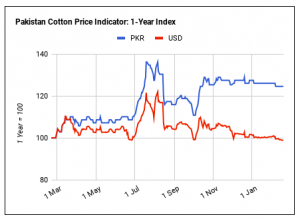
The benchmark KCA cotton indicator has lost Rs.100 per maund to Rs.8,600 per maund.
Cotton prices should remain very firm in Pakistan, due to a lack of domestic supply in the country.
The yarn prices have not moved on the export market, over a weakness of demand from the Chinese customers in the current period.
The export market prices should however stay very firm in Pakistan, as stocks for siro yarns have already reached the lowest possible levels.
At the same time, Poly-Cotton (PC) and Poly-Viscose (PV) yarns have continued increasing on the Faisalabad and Karachi yarn markets.
16s PC has gained Rs.2 (or 1.40%) per lb, whereas 20s PV has moved up by Rs.2 (or 1.47%) per lb.
Polyester Staple Fiber (PSF) prices have not changed in last seven days in Pakistan, in line with the stability of import offers from the Chinese suppliers.
The benchmark 1.4 denier PSF has been stuck at Rs.193 per kilo for the last four weeks, with margins remaining at record levels at the domestic polyester plants.
Polyester spun yarn prices have also not moved, as a result.
Viscose staple fiber prices have also continued remaining very stable, with unchanged import offers from the foreign suppliers.
Viscose spun yarns have stopped rising, whatever the sharp rise of demand from the textile producers in the past period.
Source: Emergingtextiles