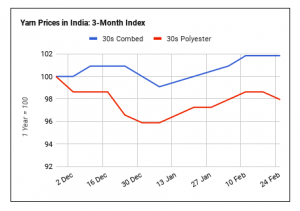
Cotton yarn prices are now stabilized in India whereas blended yarn prices are slightly falling. The decline of the rupee and the rise of the renminbi could now boost cotton yarn exports to China which have dramatically fallen at the end of last year, as reflected by our comprehensive export data covering last December and full last year per destination.
Yarn prices are mostly stabilized in India, as already observed in the past week, and could now begin declining over a lack of demand from foreign buyers.
In Punjab, 100% polyester and poly-cotton prices have already lost one to two rupees per kilo in the past seven days.
Polyester-viscose prices have also dropped one rupee in Bhiwandi (Maharashtra) and in Tirupur (Tamil Nadu).
Cotton prices are staying at a relatively high level, having stopped declining in the past days, over heavy buying from state-controlled CCI (Cotton Corporation of India).
Market prices are therefore not far from minimum support prices which have been set at significantly higher levels this year.
Demand for foreign cotton is also expected being strong this season, as recently confirmed by the US Department of Agriculture (USDA).
Their post in New Delhi also expects that cotton use will be higher in the current season, meaning that cotton yarn production will further increase.
Exports to China have plunged in December
India’s cotton yarn exports are highly dependent on the level of cotton fiber prices and the change in domestic currency value.
Shipments to foreign nations have sharply dropped in December, losing more than 20% from the year earlier in volume terms, due to the rebound of the Indian rupee.
Exports to China have plunged by 45% in December from a year earlier, dropping 28% to Pakistan but further surging to Bangladesh.
If considering the full last year, India’s cotton yarn exports have however risen 10.6% in volume terms thanks to the good results of the first part of the year when the rupee was falling.
The current rebound of the renminbi allied with the new decline of the rupee could now boost cotton yarn exports to China where demand for yarns is however depressed by the economic slowdown and the low level of apparel exports to foreign countries.
Source: Emergingtextiles