1. GIÁ CẢ THỊ TRƯỜNG
A. Tình hình nhập khẩu NPL dệt may tuần từ ngày 12/04 ~ 20/04/2022

Nguồn: VITIC
B. Giá cả thị trường tuần 18/04 ~ 22/04/2022


2. BIẾN ĐỘNG GIÁ


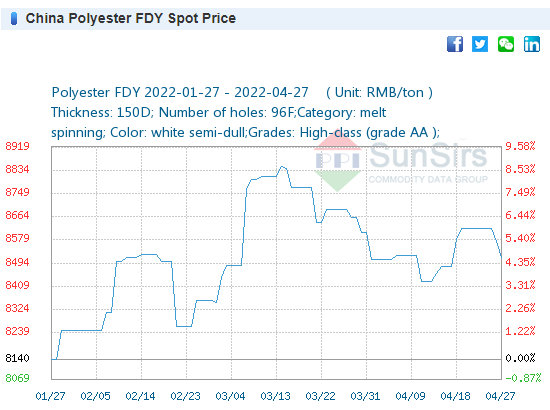


3. TIN THỊ TRƯỜNG
‘Có thể tạm thời cấm xuất khẩu bông’
Bộ trưởng Dệt may Upendra Prasad Singh nói với trang tin tức Mint rằng chính phủ liên bang có thể áp đặt lệnh cấm tạm thời đối với xuất khẩu bông nếu giá bông tiếp tục tăng cao. Thông báo được đưa ra trong bối cảnh giá bông và sợi trong ngành dệt may Ấn Độ tăng cao, ảnh hưởng đến sản xuất và xuất khẩu.
Giá bông đã tăng gấp đôi trong vòng chưa đầy một năm lên hơn 90.000 Rupee/candy. Một số loại bông thậm chí còn có giá 100.000 Rupee/candy. Một lệnh cấm có thể giúp điều chỉnh giá bằng cách giải phóng bông cho thị trường nội địa.
Giá bông cao có tác động không cân xứng đến ngành dệt may của Ấn Độ vì nước này phụ thuộc rất nhiều vào bông, không giống như các thị trường khác nơi xơ nhân tạo chiếm thị phần lớn hơn.
Theo ông Singh, giá bông khó có thể giảm trước tháng 10, khi vụ bông mới đến. Ông cho biết, giá bông là một lực cản và vấn đề này có thể còn tồn tại trong một thời gian do tình trạng khan hiếm bông trên toàn cầu.
Thông báo được đưa ra một tuần sau khi chính phủ miễn thuế đối với bông nhập khẩu cho đến tháng 9. Trước đó, bông nhập khẩu bị đánh thuế 11%. “Giá bông không giảm nhiều như chúng tôi mong đợi. Nó cũng không tăng, có lúc đình trệ. Chúng tôi đang đánh giá các hành động tiếp theo và lệnh cấm xuất khẩu tạm thời hoặc hạn chế định lượng để kiểm soát giá là một lựa chọn, ông Singh nói.
“Tuy nhiên, các quyết định chính sách không nên không chắc chắn hoặc phản ứng vội vàng và đây là những bước đi cực đoan – nhưng chúng tôi sẽ làm như vậy nếu cần thiết,” ông nói thêm.
Các chuyên gia cho rằng giá tăng đột biến có thể là do Hoa Kỳ cấm nhập khẩu các sản phẩm bông từ khu vực Tân Cương của Trung Quốc. Các nhà sản xuất dệt may cho biết nhiều nhà sản xuất đã phải cắt giảm sản lượng do chi phí đầu vào tăng. Trong khi khách hàng đã phải chịu đựng sự tăng giá “tới mức có thể xảy ra”, các nhà sản xuất quần áo lo sợ sẽ có sự phản kháng trong tương lai.
Các nhà sản xuất cho biết việc miễn thuế nhập khẩu có lợi hơn nếu bông có sẵn ngay sau khi đặt hàng nhập khẩu. Tuy nhiên, phải mất gần ba tháng kể từ ngày đặt hàng mới có bông, và việc miễn thuế chỉ đến tháng 9.
=========
‘Temporary ban on cotton exports likely’

The Union government may impose a temporary ban on cotton exports if cotton prices continue to surge, textiles secretary Upendra Prasad Singh told Mint. The statement comes at a time when the Indian textile Industry is reeling under a spike in cotton and yarn prices, impacting production and exports.
Cotton prices have doubled in barely a year to over ₹90,000 per candy. Prices of some varieties of cotton have even touched ₹100,000 per candy. A ban could free up cotton for the domestic market and thus help soften prices.
High cotton prices affect the Indian textile industry disproportionately, as it is heavily dependent on cotton, unlike other markets where man-made fibre occupies a larger share.
Singh said cotton prices are unlikely to decline before October when the new cotton crops arrive. Cotton prices have been a “dampener” and the problem could persist for some time as there is a global shortage of cotton, Singh said.
The statement comes a week after the government waived customs duties on imported cotton until September. Earlier, cotton imports were effectively taxed at 11%. “Cotton prices haven’t softened as we expected them to. It is not rising too, it’s stagnant at a point. We are evaluating the further course of action and temporarily banning export or imposing quantitative restrictions to check prices is an option,” Singh said.
“However, policy decisions should not be uncertain or a knee-jerk reaction and these are extreme steps — but if there is a need we will do it,” he added.
The price surge can be traced back to the US ban on the import of cotton products from China’s Xinjiang region, experts said. Textile manufacturers said many of them have had to cut production because of rising input costs. While customers have borne rising prices “to a certain point”, garment manufacturers apprehend resistance going forward.
Manufacturers said the import duty exemption would have been more beneficial if cotton were immediately available after placing an import order. But it takes nearly three months to get the cotton from the date of placing the order and exemption has been given only until September.
Source: Mint
- Dữ liệu giá được tham khảo từ thị trường Trung Quốc và Tổng Cục Hải quan Việt Nam.
- Tham khảo dữ liệu giá hàng tuần và lịch sử biến động giá để có thông tin về biên độ biến động giá cả thị trường qua từng kỳ vì đơn giá sợi tham khảo từ thị trường Trung Quốc và các nước khác với đơn giá sợi sản xuất tại Việt Nam.
- Bài viết phân tích, nhận định và đánh giá về giá cả thị trường tham khảo từ nhiều nguồn thông tin. Tiếng Việt do VCOSA dịch và biên tập. Luôn có bản gốc để đối chiếu ngay dưới mỗi tin.
- Một số thông tin giá sợi bị ẩn vì quyền riêng tư (chỉ dành cho hội viên VCOSA), vui lòng liên hệ Hotline +84-902379490 để gửi yêu cầu và nhận thông tin thêm.
- VCOSA đang tìm kiếm thêm nguồn dữ liệu giá từ các thị trường trọng tâm để bổ sung đầy đủ hơn. VCOSA cũng trong giai đoạn xây dựng bộ dữ liệu giá nhập khẩu sợi vào Việt Nam và giá sợi sản xuất tại Việt Nam và sẽ sớm ra mắt.
==============
- Price database is referenced from the Chinese market and the General Department of Vietnam Customs.
- The unit price of yarn referred from Chinese market and other countries which is different from the unit price of yarn produced in Vietnam, so please refer to the weekly price data and historical price fluctuations for the range of market price fluctuations per period.
- The article analyzes, comments and evaluates the market price referenced from many sources. Translated and edited by VCOSA in Vietnamese. There is always an original to compare just below each news.
- Some yarn price information is hidden for privacy (VCOSA members only), for more information, please call our hotline at + 84-902379490.
- VCOSA is looking for more sources of price data from major markets to make it more complete. VCOSA is also developing a dataset of import prices of yarn to Vietnam and prices of yarn produced in Vietnam, which will be available soon.